
 Perhaps it was the slant of late afternoon sunlight filtering through
the vine-laced pergola, gracing the plank of organic crudités. Maybe
it was the large grape leaves serving as blotters and platters for the
abundant array of fresh foods presented that perfect June day.
Perhaps it was the slant of late afternoon sunlight filtering through
the vine-laced pergola, gracing the plank of organic crudités. Maybe
it was the large grape leaves serving as blotters and platters for the
abundant array of fresh foods presented that perfect June day.
Of course, it also had to be the occasion. It was 1984. Northern
California was still new to Manhattanite me. We were celebrating the
opening of my girlfriend Jessel’s Gallery, birthed in an abandoned
granary building on Atlas Peak Road down the hill from the Silverado
Country Club in Napa. Diane Jessel, an artist, author, impresario,
was a patron of other female artists, and had a gallery full of gifted
gals’ tantalizing take away ceramics, California impressionist
canvases, and funny, functional, folk art pieces.
But I had NEVER seen a tuna salad quite like that one...
Food, Family and Memory
Food, Family, and Memory
Pickle Memories
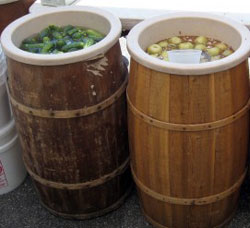 Everyone in America has a childhood pickle memory, some great memories of the perfect pickle and some less notable. When my sister and I were kids there was a small pickle company located a couple of towns away and all the local grocery stores in the area had a 55 gallon wooden pickle barrel of their pickles with tongs and plastic bags for you to help yourself. On the side of the barrel was a sign that offered a free pickle to children under 7 years old, a brilliant marketing campaign to capture the next generation of customers. Well, they had me as a loyal customer after only one pickle!
These pickles were really a sour mustard pickle, a rather harsh sensation for a delicate young mouth. I trained myself to enjoy the intense sour flavor by eating slowly, but not waiting too long in between small bites so my mouth wouldn't burn. The company name was the Hescock Pickle Company. It was located on a bucolic bend in the Kennebec River with 3 large outside cement pools where the pickles cured. All the farmers within a 50 mile radius raised white spine pickling cucumbers for this company to help raise enough money to pay their real estate taxes.
Growing Up With The Help
 The Help surprised some people that Southern whites could
treat their servants with so much inhumanity in the 1960's. I was
shocked by a few specific incidents, but not surprised. I saw it close
up as a child. Not in Jackson, Miss., where the story is set, but in my
hometown of Beverly Hills where the help was almost exclusively
'negro,' before the Black Power Movement and the influx of Hispanic
housekeepers and nannies in the late 70's and early 80's.
The Help surprised some people that Southern whites could
treat their servants with so much inhumanity in the 1960's. I was
shocked by a few specific incidents, but not surprised. I saw it close
up as a child. Not in Jackson, Miss., where the story is set, but in my
hometown of Beverly Hills where the help was almost exclusively
'negro,' before the Black Power Movement and the influx of Hispanic
housekeepers and nannies in the late 70's and early 80's.
My overly emotional reaction to the film puzzled me. Good story, great performances, but floods of tears? On the drive home, memory hit and re-opened an old wound that I had hidden away. Of course... ESMUS HEMPHILL, our black maid in the 50's & 60's who was let go when I left for college and who I never thanked enough for all she did or properly protected her against my mother's unconscious cruelty towards her.
My mother, born into working class Memphis in 1925, became politically liberal, but personally she still carried a few racist seeds in her DNA. She would sit at the head of our dining table in Beverly Hills and ring a sterling silver bell to signal to Esmus that it was time to serve.
Company Cherry Chicken
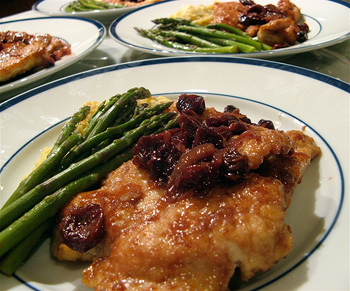 We had friends to dinner the other night, a nice little party with flowers and wine and Josie upstairs. These days I like making it nice but not stiff, special without fuss – but just a few years back it was all fuss all the time – to a newly minted chef girl, married girl, grown-up girl, hosting meant acrobatic recipes, exotic combinations, an absurdly high drive to please.
Our first true guests were from my husband’s office, a funny and casual couple who were treated to undercooked, over-garlicked lamb and several under-mixed, over-ginned martinis. The evening would feature a clogged sink, dishwater buckets, our crotch-poking Dalmatian and one seriously wailing fire alarm. The last thing they saw was Greg broom-whacking the smoke detector and me at the sink, right hand down the drain and left hand in the air. Bye, great having you! Everyone meets these horrors, but why? When you turn 25 they should hand you a pamphlet called Hosting! Relax and Don’t Try Anything New. Let’s face it, the clues were there – the oven temp was off, I’d never mixed martinis, I tied that lamb loose as a blind butcher. I could have seared steaks or made cheese fondue or even flipped omelets. I could have used a standby.
A lot of people say they don’t do standbys, they prefer something new, something dazzling, an unknown mushroom or an expensive hunk of cheese. Okay, dazzlers: I don’t care if you’re Julia Child, there are people coming at seven. That mushroom could taste like dung and the cheese might hit the floor, so do what you know. Do what you do well, be comfortable and your guests will be comfortable, do a standby.
I Will Never Do It Again
 Several years ago (about four), I threw a surprise birthday party for the Wild Boar. All I really wanted was for him to be "surprised" and he was. I ordered formal invitations and sent them out with the words, "No Gifts" on the bottom.
How could I expect people to bring him gifts when he and I do not even exchange birthday presents. There is nothing we need/want! I thought I was doing everyone a favor.
Of course everyone showed up with very generous, thoughtful and lovely gifts, even though it wasn't necessary. It was a great party and we still have good memories of that night.
However, fast forward to now. My children have just received their sixth birthday party invitation this year that says "No Gifts". Ugh.
OMG, I will never, never, ever, never put that statement on another party invitation as long as I live.
More Articles ...
Check out--
-
Labor Day BBQ Specials
 Bacon-Wrapped Shrimp
Cowboy BBQ Burger
Buttermilk Fried Chicken
Alan's Grilled Salmon
Barbecue Beer Ribs
Mango Shrimp KabobsEvelyn Hall’s Baked Beans
Chili Butter Corn on the Cob
Mac and Cheese
Mediterranean Orzo Salad
Old Fashioned Potato SaladTomato & Avocado Salad
Watermelon, Feta & Mint Salad
Lulu's Tastiest Coleslaw
Suzanne Goin's SuccotashThe Bootleg | Cuba Libre | Dark 'n' Stormy | Mai Tai | Margarita | Mojito | Sassy Sangria
Sea Breeze | Tequila Sunrise | Tequila Gimlet | Watermelon FallsAlmond Pear Pie | Apple Pie | The Best Brownies Ever | Blackberry Pecan Crisp
Maple Bacon Chocolate Chip Cookies | Crunchy Ice Cream Sandwiches
Grandma Hazel's Lemon Cake | Peach Cobbler | Plum & Toasted Almond Galette
S’mores Cookie Bars | Fresh Strawberry Pie | Whoopie Pies
-
Turkey-Butternut Tortilla Soup with Zesty Lime Sour Cream
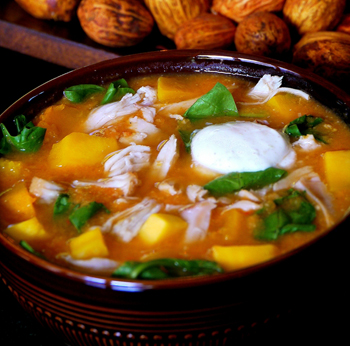
For the soup:
3 cups cooked turkey, shredded
1 butternut squash
1¼ cups onion
1 cup corn
4 garlic cloves
1 jalapeno
3 Tablespoons olive oil
3 corn tortillas
2 cups tomatoes
3 Tablespoons tomato paste
1 Tablespoon ground cumin
6 cups chicken broth
6 ounces spinach
Salt and pepper to tasteFor the sour cream:
½ cup sour cream
1 Tablespoon lime juice
Zest of one lime
¼ teaspoon ground cumin
Welcome to the new One for the Table ...
Our Home Page will be different each time you arrive.
We're sure you'll find something to pique your interest...