
Food, Wine, Good (and Evil) Spirits

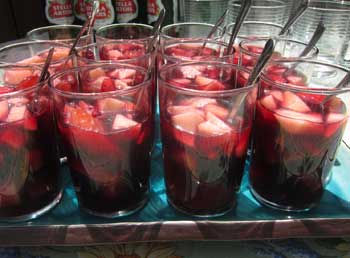
sangriaWhen summer temperatures go up, my appetite goes down. I want less to eat and more to drink. Homemade lemonade with mint is a great favorite. Iced tea in a tall glass filled with cracked ice is a great way to cool down. On a recent trip to Spain, I rediscovered sangria, which might be the best remedy for double and triple digit heat waves.

In the summer, the Iberia Peninsula bakes under an unforgiving sun. Spaniards long ago learned that the best way to beat back the effects of hot weather is to eat small plates ("tapas") and drink wine flavored with fresh fruit.

When I was served a glass of sangria in a bar in San Sebastián, a small resort town on the coast of Northern Spain, I loved the way fresh fruit added flavor to the wine. Fortified with brandy and sugar, sangria goes well with small sandwiches, salads and snacks.

Visit Spain and you'll see sangria pitchers. Wide at the base, the large pitchers have a spout narrowed at the end. When the pitcher is made, the potter gently pinches the spout to narrow the opening, allowing the wine but not the fruit to enter the glass.

Read more ...

Clementine MargaritaYou have about a month to make these before Clementine season is officially over. Don't miss it. 

Have you ever had a Clementine? They are tart, tangy and have a slight sweetness to them. A cross between a mandarin and a sweet orange, they are easy to peel and taste slightly different than both. It has distinct enough flavor that I always make sure I enjoy them throughout the season.

And here's the thing, they are supposed to be seedless, however I am having a hard time finding seedless Clementines. I've heard they lose their desirable seedlessness when they are cross-pollinated with other fruit, bees are the usual culprit.

My latest batch of Clementines was full of seeds, which made them a much better vehicle for making margaritas than just peeling and eating them.

Read more ...

pomdrinks1We were really happy to sample the new PomWonderful drinks as a prelude to the holiday season. Pom Mango, Pom Hula, Pom Coconut. And since we’re not going away for Christmas this year, it was an excuse to pretend we were lounging under an umbrella on the beach, listening to the waves pound against the shore, and watching the sunset as we tasted the new varieties. (For the record, these were sent to me as samples, but as people who know me know, I don’t always write about the samples that I’m sent, not unless I like them, anyway – those crabcakes shaped like baseballs come to mind...)

But the new Pom drinks are really fresh – they have to be refrigerated – and they’re so luscious, they work as a snack instead of food. And if I have anything to say about it, they will now be a staple in our house...

The Pom Mango is pure deliciousness, fresh, and amazing. The Pom Hula makes you a little less sad you’re not on the beach. And the Pom Coconut (well let me say this, coconut cake is my favorite thing) so I was already there.

But then we decided to a little cocktail experimentation. For the record, this involved tasting only (kind of like a wine day), although spread over many, as it’s my personal belief, and potentially an old rock and roll adage, that you’re not supposed to mix hard alcohol on any given day.

Read more ...

savinoThough I love wine, I don’t own much wine paraphernalia. Good glassware and a sturdy corkscrew is pretty much all anybody needs. Carafes are nice for entertaining. Aerators a possible necessity if you’re drinking a lot of young red wine, but I generally spend my wine dollars on wine. We have a fairly large cellar and once people find out how many bottles we have - enough to survive a year without buying more, not so much we couldn’t drink it in our lifetime - the first question is always “how much do you drink?” Let’s just say there are two of us, usually one bottle a day…you can do the math.
Leftover wine is rarely an issue in our house. Yet not everyone has a nightly wine buddy and some people just like to have a glass with dinner. Others like to try several different ones at a time. How do you make sure the wine stays as fresh as possible? Once you pull that cork oxygen begins it’s hack job trying to turn your luscious vino into vinegar. I’ve found the “re-cork it and refrigerate it” method works pretty well with most red wine, since - except for very old ones. Most reds could use a little opening up and many are better the next day doing this. However, if you’re not going to get to the wine for a few days you’re really taking a gamble. Especially if you really LOVED it the first night. (Our advice when that happens - drink it all. Seriously.) When it comes to white wines or rose, you’re pretty much guaranteed to be disappointed the next day if you don’t take some precaution against oxidation other than refrigeration.

When I got the chance to try the Savino, I figured why not give it a spin?

Read more ...

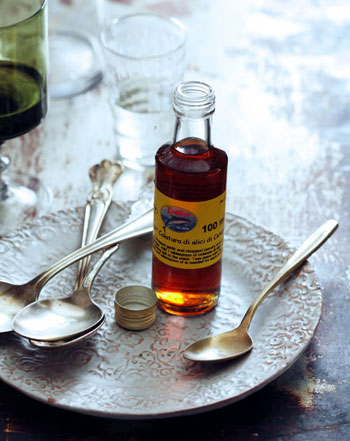
colatura-bottle-blog.jpgWhen you live, breathe, eat and sleep food, it can sometimes be hard to muster excitement. This doesn’t mean I’ve grown weary of food and all it involves, it just means that it takes a little extra or a tiny bit of sumthin’ sumthin’ to really knock my socks off. Not that they need constant knocking off. They don’t. I’m happy with plain most of the time.

The pleasures of food and discovery happen when you least expect it. I can remember a moment 20 years ago when I had my first Meyer lemon and I thought the earth would swallow itself. My mind was expanding with each taste of that glorious citrus and I knew life would never be the same. The same can be said of having Jamon Iberico de bellota, a proper supplì, even Wisconsin cheese curds for the very first time. I can count those moments on one hand.

Last month in Italy I had another one of those moments at dinner. It was a fish dish with a very simple aioli––or so I thought. It turns out that the aioli was made with Colatura, an extremely flavorful Italian condiment made from fish and salt. My eyes must have given my excitement away as our dinner neighbor Fabio looked at me and said “It’s Colatura. There’s Colatura in here.” He explained how it’s made, telling me fish sauce has been used for thousands of years in Italy.

Read more ...